Owning a running store has allowed me to experiment with loads of shoes in a variety of applications, to the point where I am overwhelmed with options when I head out the door. In the last few years, we’ve seen brands invent whole new categories inside what was once a pretty clear shoe hierarchy. This has made what used to be easy choices much harder. Not just from a buying perspective for the store, but in a practical sense.
I wanted to lay out what I think is the right mix of shoes for a strong rotation. This list isn’t for everyone; I’m well aware it’s not feasible for everyone to want all these options. Nor does a casual, two-day-a-week runner necessarily need them. But if you’re looking to extend your miles this year or just be a little more intentional when heading out, here is how I would build my shoe-tation if I was starting over today.
1. The Daily Trainer
The meat and potatoes. This used to be an easy category dominated by models like the Brooks Ghost, NB 880, or ASICS Cumulus. Now, those models have been replaced by what brands call a “performance trainer.” It is essentially a daily shoe with a higher-performance midsole or a more aggressive geometry. With more people adding plates to shoes, models that used to be fine for your daily miles now feel outdated. Brands have been tinkering with foam formulas to provide lightweight, bouncy shoes for your “junk” miles during the week. When I think of a performance trainer, models like the Adidas EVO SL, the ASICS Novablast, or the Altra Flow come to mind. These shoes are priced similarly to old-school trainers but offer a much more fun ride.
2. The “Go Fast” Shoe
This is for when you want to do a workout on the track, pick up the pace during the last mile of a mid-week run, or race a local 5K. I think of this differently than a marathon racing shoe. I want something a little narrower that offers a rocker or shape advantage and feels lighter than my daily shoe. This is where a plastic plate might come in. For this, I think about options like the Hoka Mach X, KipRun KipStorm Tempo, or the ASICS Magic Speed.
3. The Trail Shoe
Depending on where you live or your schedule, it’s nice having a trail shoe in the mix. We’ve seen two major changes in trail shoes lately: versatility and carbon plates. Depending on the type of runner you are, neither may make sense. For those just hitting the dirt once a month, a hybrid shoe may be all you need—something that can double as a crappy weather/vacation/hiking/gravel road shoe. Most people come into the shop with their eye on a rugged trail beast, but usually, a hybrid model with a durable outsole will suffice. Options like the Altra Lone Peak, Hoka Challenger ATR, or Brooks Cascadia do the trick.
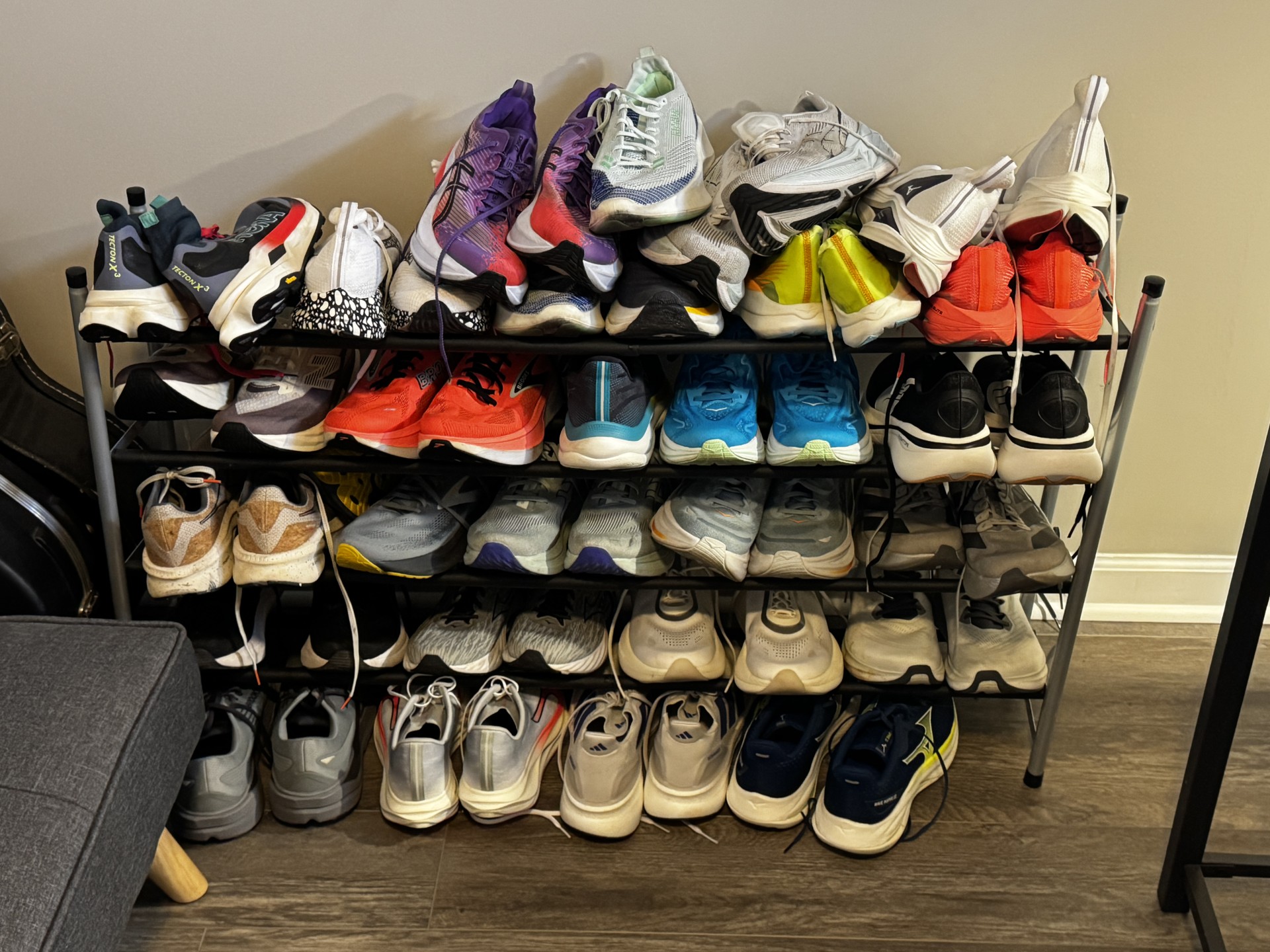 A good shoe shelf should always look like a semi-disaster
4. The LSD Shoe (Long Slow Distance)
As I’ve gotten older, this has become the most important shoe in my rotation. For those who get out weekly for some good old-fashioned Long Slow Distance, the right shoe means the difference between a nice bounce-back Monday or dragging your body through the start of the week. While I can get by with many options for a “putz around town” run, if I am going to be pounding the pavement for serious mileage, I need the right tool. I want something that takes the beating, stays comfortable, and leaves me feeling fresh.
I went through a plated LSD phase a few years back and it left my toes aching. Older and wiser, I now choose width and cushion over plates for these miles. This is where oversized “super-trainers” excel—shoes I can pitter-patter along in without much care for pace. Lately, I have been enjoying shoes like the ASICS Superblast, KipRun KipRide Max, Brooks Glycerin Max, or even the Puma MadMax.
5. The Recovery Shoe
I’m skipping racing shoes for now to mention one of the most slept-on pieces in your rotation. I frequently observe people coming in with foot issues because they don’t take care of their feet outside of running or work. As we approach flip-flop season, it’s a good reminder to take care of your “dogs” when you’re out of your running shoes. Look for something that protects your arch and has a little heel lift. There are great options like Hoka Ora Slides or Oofos. A personal favorite of mine (which we don’t carry) is Kuru. When I was dealing with a bad Achilles injury, my Kuru slides—with their 12mm drop and stable arch—are what finally got me back to running. If you’re determined to stay barefoot at home, at least try a pair of OS1st Plantar Fasciitis socks to add some support.
Hope that helps you in your quest for a healthy shoe balance. From time to time we get asked what the “best shoe on the wall” is, which is an impossible question. If there were one perfect shoe, we’d only carry one shoe. Every model is there for a reason; as more niche categories arise, it’s just about knowing why they exist and if they actually serve you.